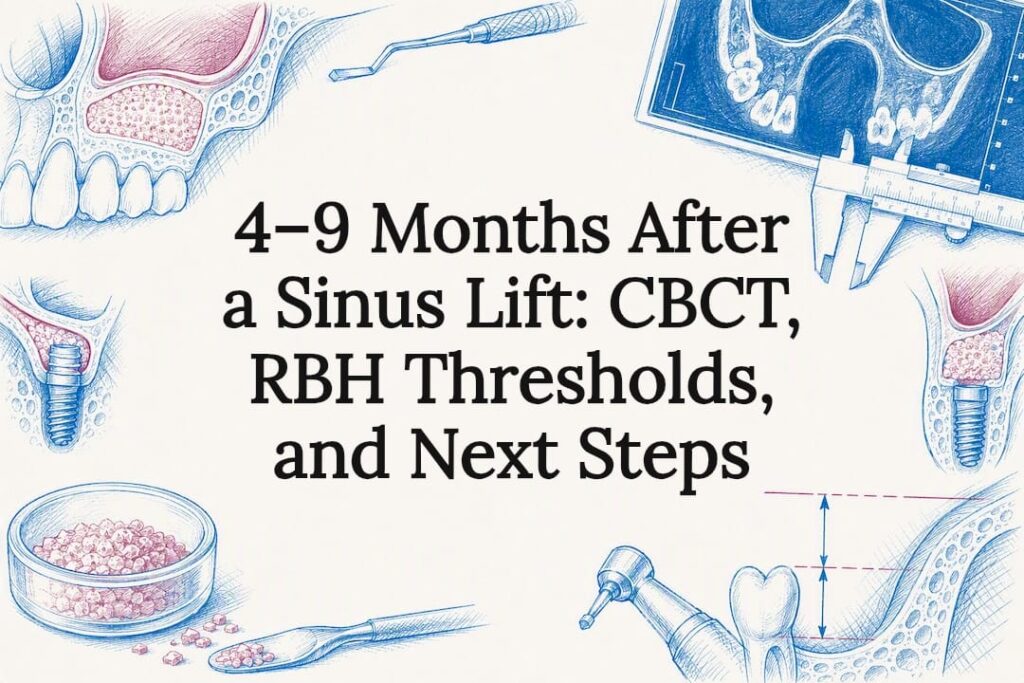
A sinus lift raises the floor of the maxillary sinus and packs bone graft into that space so a dental implant has enough height and density to anchor in the upper jaw. Surgeons turn to it when residual bone height in the back upper jaw falls below what an implant needs for primary stability, usually somewhere under 8 to 10 millimeters. If a CBCT scan shows that shortfall, the next real step is a consult with an oral surgeon or periodontist who can measure your sinus anatomy and map a plan.
TL;DR:
- A residual bone height under 8 to 10 millimeters typically requires a sinus lift for implant stability.
- The lateral window approach is preferable when bone height is 5 millimeters or less, due to its predictability for severe resorption.
- CBCT imaging is essential for precise measurement of the sinus and residual bone height before planning the procedure.
- Sinus lift healing generally takes 4 to 9 months, with implant placement sometimes possible during the same surgery if enough native bone remains.
- Complications like membrane perforation are common but manageable, especially with careful planning and experienced surgeons.
questions about this? we're happy to help.
Every patient's situation is a little different. If you want to talk through what this means for you, our Greenville team is one call away.
schedule a free consultationTable of Contents
- What a Sinus Lift Does and Why Implant Stability Depends on It
- Who Needs a Sinus Lift: Signs and the Diagnostic Workup
- Lateral Window vs. Crestal Approach: How Surgeons Choose
- From Consultation to Healed Graft: The Procedure Step by Step
- Sinus Lift Risks: What Can Go Wrong and How It Gets Fixed
- Recovery Timeline: What to Expect Week by Week
- Alternatives to a Sinus Lift Worth Discussing
- How Complete Dental Care Approaches Sinus Lift Cases
- Ready to Find Out If You Need a Sinus Lift?
- Sources
- FAQ
What a Sinus Lift Does and Why Implant Stability Depends on It
Your upper jaw bone starts thinning the moment a molar or premolar disappears. Two things drive that loss at once: the bone that used to hold the tooth root stops getting chewing pressure and begins to resorb, and the maxillary sinus, an air-filled cavity that sits directly above the back teeth, expands downward to fill the space. Dentists call that second process pneumatization, and it’s the reason so many patients who lost upper back teeth years ago show up for implant consults with barely any usable bone left.
Implants need a minimum amount of bone height and density to achieve what’s called primary stability. That’s the mechanical grip an implant gets in bone immediately after placement, before any biological healing has occurred. Without it, the implant can shift, fail to integrate, or simply not have enough surrounding structure to support chewing forces for decades. A sinus lift solves this by lifting the thin membrane lining the sinus floor and filling the resulting space with graft material, effectively rebuilding the vertical bone an implant needs.
A few anatomical realities make this more common than people expect:
- The upper back jaw naturally has less dense bone than the lower jaw, so it starts with a smaller margin to lose.
- Sinuses vary widely in size and shape from one person to the next, and some expand much faster after tooth loss than others.
- Long-term denture wear tends to accelerate bone resorption in this area, since dentures put pressure on the ridge rather than stimulating it the way a tooth root does.
Not every patient with low bone height needs augmentation. Short implants, angled placement, and zygomatic implants exist as alternatives, covered later, but a sinus lift remains the most direct route to enough bone volume for a standard implant.
Who Needs a Sinus Lift: Signs and the Diagnostic Workup
If you’ve been missing an upper molar or premolar for more than a year or two, there’s a reasonable chance your sinus has expanded into that space already. The clinical picture that points toward a sinus lift for implants usually includes a few recognizable patterns:
- Long-term tooth loss in the posterior maxilla. The longer the gap, the more bone has typically resorbed and the more the sinus has dropped.
- Low residual bone height (RBH) on imaging. This is the actual vertical measurement, from the crest of the ridge to the sinus floor, that determines whether augmentation is needed and which technique fits.
- History of periodontal disease or previous extractions with visible ridge collapse. Gum disease accelerates bone loss well beyond what age alone would explain.
- Denture wear over many years without any implant support, which tends to correlate with more advanced resorption than tooth loss alone.
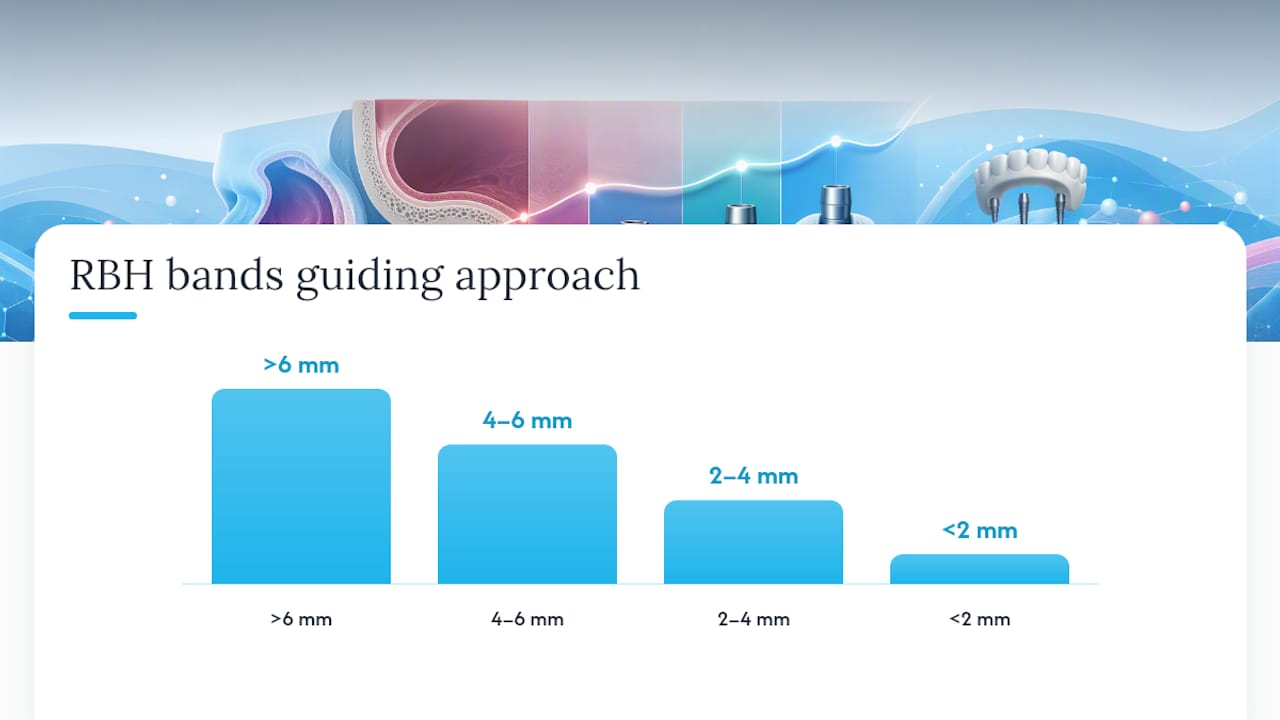
RBH is the number that actually drives the treatment plan. Reviews of current sinus lift techniques generally place the dividing line around 5 millimeters: below that, a lateral window approach is typically favored, while more bone height opens the door to less invasive options. Some decision frameworks break this down further into bands, roughly above 6 millimeters, 4 to 6 millimeters, 2 to 4 millimeters, and under 2 millimeters, each pointing toward a different approach and level of surgical complexity.
Getting that number right requires 3D imaging, not a flat two-dimensional X-ray. A CBCT scan (cone beam computed tomography) lets your surgeon see the sinus in three dimensions, spot septa or unusual anatomy inside the cavity, and measure lateral wall thickness before ever picking up an instrument. Your surgeon will also review your sinus health history, ask about smoking, and may refer you to an ENT specialist if you have a history of chronic sinusitis or nasal polyps, since active sinus disease changes the risk calculation considerably.
Lateral Window vs. Crestal Approach: How Surgeons Choose
The two established techniques for sinus lift surgery solve the same problem through very different routes, and which one you get usually comes down to that RBH number more than surgeon preference alone.
The lateral window approach, sometimes called the direct approach, involves opening a small window in the side wall of the sinus, lifting the membrane from inside, and packing graft material directly into the newly created space. It’s the more invasive of the two techniques, but it also allows for the largest and most predictable volume of new bone. This is generally the technique of choice when residual bone height is around 5 millimeters or less, according to a detailed review of current sinus lift techniques, because there simply isn’t enough native bone left to work through a smaller access point.
The crestal, or osteotome, approach works from the top down. The surgeon accesses the sinus floor through the same site where the implant will eventually go, using a specialized instrument to gently push the floor upward and create room for graft material, often at the same visit as implant placement. Research on membrane elevation techniques generally favors this route when residual bone height exceeds roughly 5 to 6 millimeters, since less invasive access is sufficient and recovery tends to be faster.
A few things separate the two in practice:
- Lateral window surgery takes longer in the chair and involves a longer soft-tissue recovery, but it’s the more reliable option for severely resorbed sinuses.
- Crestal approaches cause less swelling and discomfort, and implants can sometimes go in on the same day.
- Newer adjuncts, including balloon elevation, hydraulic lift systems, and piezoelectric instruments, are giving surgeons gentler ways to lift the membrane crestally, which is expanding the range of cases that can skip the more invasive lateral window.
Pro Tip: Ask your surgeon which technique they recommend and why, specifically what your RBH measurement is and how it factors into the decision. A surgeon who can walk you through that number in plain terms is usually one who has done the CBCT homework properly.
From Consultation to Healed Graft: The Procedure Step by Step
Before anything gets cut, your surgeon reviews your CBCT scan in detail, confirms your medical history, and talks through anesthesia options. Most sinus lifts are done under local anesthesia with the option of oral or IV sedation for patients who feel anxious about oral surgery, which covers the overwhelming majority of people considering implants in the first place.
On the day of surgery, the sequence depends on which technique your case calls for:
- Access. For a lateral window, the surgeon opens a small oval window in the side of the sinus wall. For a crestal lift, access comes through the implant site itself.
- Membrane elevation. The thin Schneiderian membrane lining the sinus is carefully lifted away from the bone, creating a pocket for graft material.
- Graft placement. The surgeon packs the new space with bone graft material, choosing between several options depending on the case.
- Closure, and sometimes implant placement. The site is closed with sutures. If bone height and quality are sufficient, the implant may go in during the same procedure; otherwise, the graft is left to mature on its own.
Graft material choice matters more than most patients realize going in. Autograft (bone taken from your own body, often the chin or jaw) integrates fastest but requires a second surgical site. Allograft (processed donor bone) and xenograft (typically bovine-derived bone mineral) are far more commonly used because they avoid a second surgery and have a long track record, though they remodel more slowly. Synthetic (alloplast) grafts offer a fully manufactured alternative with no donor tissue at all. No single material wins outright. Reviews of membrane elevation and grafting outcomes note that choice depends heavily on surgeon preference, patient factors, and whether the implant goes in immediately or later.
Whether your implant goes in the same day or waits comes down to a fairly simple rule: if there’s enough native bone left to give the implant primary stability on its own, your surgeon may place it simultaneously with the graft. If the sinus was severely resorbed and the graft is doing most of the structural work, the case gets staged, meaning the graft heals first and the implant goes in months later. Patients hoping for immediate-load, same-day implants should know that a significant sinus lift usually rules that timeline out, at least for the tooth in question.
Bone graft maturation is the part patients ask about most, and for good reason. Guidance from the American Academy of Periodontology puts typical healing at roughly 4 to 9 months before the graft is solid enough to support an implant, with follow-up imaging along the way to confirm the bone has actually integrated rather than just assuming a calendar date means readiness. That range, and why it varies so much between patients, is worth understanding before you commit to a treatment timeline, and the dental implant timeline breakdown walks through how grafting fits into the bigger picture.
Sinus Lift Risks: What Can Go Wrong and How It Gets Fixed
The most common complication during sinus lift surgery is a tear in the sinus membrane, and it happens more often than most patients assume. When it does happen during surgery, an experienced surgeon usually repairs it on the spot with a collagen patch or sutures, or in some cases simply staged the graft for later rather than proceeding immediately. Reviews of current sinus lift techniques treat membrane perforation as a manageable, well-understood event rather than a surgical emergency, provided it’s caught and addressed during the procedure itself.
Beyond the membrane, the complications patients should know about after surgery include:
- Infection at the graft site, usually preventable with prescribed antibiotics and good oral hygiene during healing.
- Graft failure or partial resorption, which sometimes requires a second, smaller grafting procedure.
- Sinusitis, particularly in patients with pre-existing sinus disease that wasn’t fully addressed beforehand.
- Temporary bleeding or nasal drainage in the days immediately following surgery.
- Rare sensory changes if nerves near the surgical site are irritated.
Anatomical factors like sinus septa, unusually thin lateral walls, and a history of chronic sinus disease raise the odds of complications considerably. Careful CBCT-based planning and an experienced surgical hand are what actually move the needle on outcomes, more than any single technique choice.
That combination, imaging and experience, is echoed across clinical reviews of sinus floor augmentation: surgeons who map the anatomy in advance and have performed enough cases to recognize risk factors early see fewer complications across the board. If you develop severe pain, fever, pus, or persistent heavy bleeding after your procedure, that’s not a “wait and see” situation. Call your surgeon’s office the same day.
Recovery Timeline: What to Expect Week by Week
The first week after a sinus lift feels a lot like recovering from any oral surgery: expect swelling, some bruising along the cheek, and mild to moderate discomfort that’s usually well controlled with prescribed pain medication. What’s different is the sinus precautions. Your surgeon will tell you not to blow your nose, avoid strenuous exercise, skip drinking through a straw, and possibly take a short course of antibiotics and a decongestant to keep pressure changes from disturbing the healing membrane.
Soft-tissue healing at the surgical site generally settles down within about a week to ten days. The graft itself, though, is on a much longer clock:
- Weeks 1 to 2: Swelling and soreness resolve; sutures dissolve or get removed.
- Months 1 to 3: The graft begins integrating with your native bone; follow-up visits check healing progress.
- Months 4 to 9: Bone maturation reaches the point where implant placement becomes viable, confirmed with imaging rather than guesswork.
- After implant placement: Osseointegration adds several more months before the final crown goes on.
The full recovery timeline for dental implants lays out how the sinus lift phase connects to everything that follows, since patients often underestimate how much of the total treatment time sits in this waiting period rather than the surgery itself.
Pro Tip: Quitting smoking, or at least pausing it well before and after surgery, is one of the few things entirely in your control that measurably affects whether your graft succeeds. Nicotine restricts blood flow to healing tissue, and it shows up in graft failure rates.
Alternatives to a Sinus Lift Worth Discussing
A sinus lift isn’t the only route to replacing a missing upper back tooth, and for some patients it isn’t the best one. Short implants, designed to work in shallower bone without any augmentation, have become a legitimate option when the remaining height, while limited, is still adequate for a shorter fixture. They skip the graft entirely and shorten treatment time considerably, though they carry their own considerations around long-term load distribution.
Angled or tilted implant placement takes a different approach: rather than adding bone, the implant is placed at an angle that avoids the sinus altogether, anchoring instead in bone toward the front of the jaw. This prosthetic-driven strategy is a cornerstone of full-arch solutions in patients missing several upper teeth.
For more severe bone loss, zygomatic or pterygoid implants anchor into the cheekbone or the back of the skull rather than the jaw itself, entirely bypassing the sinus. These require a specialist referral and represent a more advanced surgical undertaking, but they can open a path to fixed teeth for patients who’d otherwise be told augmentation isn’t feasible.
- Fixed and removable prosthetics that don’t rely on implants at all remain a valid choice for patients who decline surgery.
- Each of these alternatives trades some amount of bone-preserving benefit for a shorter timeline or reduced surgical complexity.
How Complete Dental Care Approaches Sinus Lift Cases
Every sinus lift decision at Complete Dental Care starts with 3D CBCT imaging, not a guess. That scan lets our team measure your actual residual bone height, spot sinus septa or unusual anatomy before surgery, and build a digital treatment plan around what your jaw genuinely needs rather than a one-size-fits-all protocol.
Sedation options and comfort dogs are sometimes used to help patients manage anxiety during oral surgery appointments. You’ll also get a clear answer up front about whether your case is a same-day implant candidate or a staged one requiring graft maturation first, no vague timelines. For patients exploring what grafting actually adds to their treatment plan, our breakdown of bone graft timing for implants and our video library walk through real cases and procedures so you know what to expect before you’re in the chair.
— Complete Dental Care
Ready to Find Out If You Need a Sinus Lift?
If you’ve been missing an upper molar or premolar for a while and someone has mentioned bone loss, the only way to know for certain whether you need a sinus lift is a CBCT scan and an actual measurement, not a guess based on how long the tooth has been gone. Every implant plan builds around 3D imaging and digital scanning to provide accurate information about residual bone height during the initial visit rather than requiring outside imaging first.
That matters because sinus lift cases split into very different paths: some patients qualify for implant placement the same day as their bone graft, while others need staged healing. Our surgical and implant dentistry team will tell you which category you fall into, walk you through sedation options if the idea of oral surgery makes you uneasy, and lay out a timeline you can actually plan around. If cost or scheduling is the real hesitation, ask about our membership plan options at your consult. For patients who’d rather explore practice growth resources first, digital marketing specialists like Baby Love Growth work with dental practices on the business side of things, separate from clinical care. Schedule your CBCT consult with Complete Dental Care to find out exactly where your bone height stands and what your fastest realistic path to a new tooth looks like.
This article is general information, not a substitute for advice from a qualified doctor. Consult a qualified healthcare professional about your own circumstances before acting on anything here.
Sources
- Maxillary Sinus Lift Procedures: An Overview of Current Techniques, Presurgical Evaluation, and Complications
- Sinus augmentation — American Academy of Periodontology patient information
FAQ
How Much Does a Sinus Lift for Dental Implants Cost?
Pricing depends on which technique your case requires, whether the implant is placed at the same time, and your specific anatomy, so there’s no single number that applies across the board. Complete Dental Care reviews current pricing for surgical and implant dentistry during your consultation once your CBCT scan and treatment plan are complete.
What Is the Downside of a Sinus Lift?
The main downsides are added treatment time and a real, if manageable, complication risk, mainly membrane perforation, infection, or graft failure. Most complications are addressed during surgery itself or with antibiotics and follow-up care, and experienced surgical planning with CBCT imaging meaningfully lowers those odds.
How Long Does Recovery Take After a Sinus Lift With an Implant?
Soft-tissue healing at the surgical site typically settles within one to two weeks, but the bone graft itself needs roughly 4 to 9 months to mature before it can reliably support an implant. If the implant goes in immediately, add several more months of osseointegration before the final crown is placed.
Is a Sinus Lift Necessary for Implants?
Not for every patient, only for those whose residual bone height in the upper back jaw falls below the threshold needed for implant stability, generally judged case by case on a CBCT scan. Patients with adequate bone height, or who qualify for short implants, angled placement, or zygomatic implants, may be able to skip augmentation entirely.
Can I Get an Implant the Same Day as My Sinus Lift?
Sometimes, but it depends entirely on how much native bone height remains after your CBCT scan is reviewed. When enough bone is present to give the implant primary stability, simultaneous placement is possible; when the graft is doing most of the structural work, the case is staged and the implant follows after healing.
questions about this? we're happy to help.
Every patient's situation is a little different. If you want to talk through what this means for you, our Greenville team is one call away.
schedule a free consultation