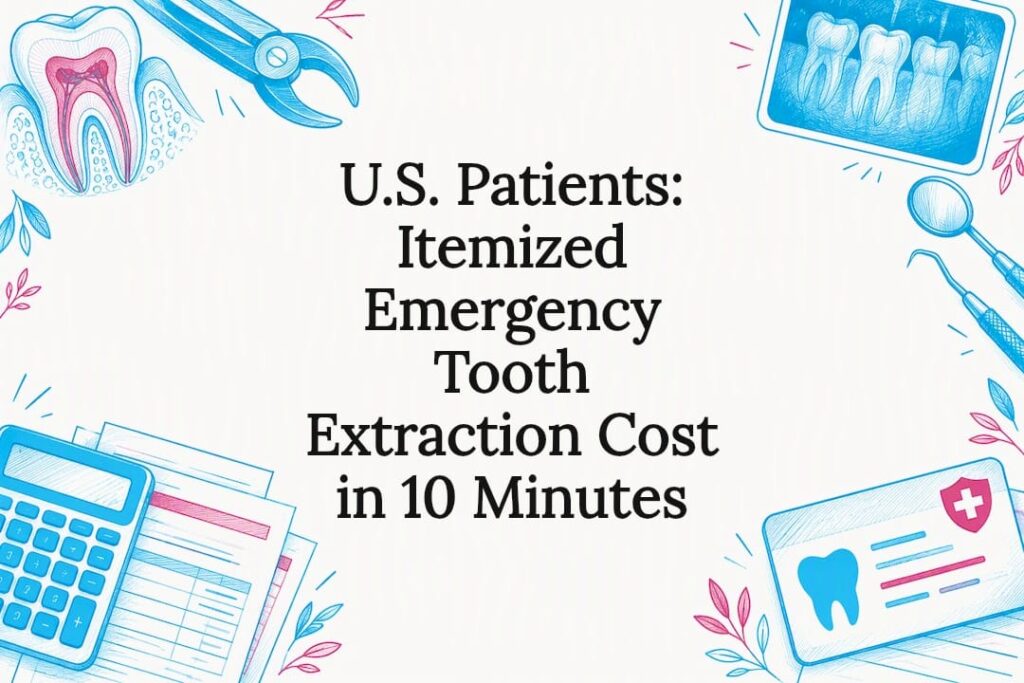
A simple emergency extraction typically costs a few hundred dollars, while a surgical or impacted extraction can cost significantly more once sedation, imaging, and facility fees are included. Your actual out-of-pocket amount depends on insurance, provider type, and how complicated the tooth is. Medicare generally does not cover it, except in specific limited circumstances. If you’re in pain or swollen, call a dentist today; if swelling is spreading, you’re struggling to breathe or swallow, or you feel feverish and unwell, go to the emergency room now.
TL;DR:
- The cost of emergency extractions varies significantly based on procedure complexity, with simple extractions typically costing hundreds and surgical ones running higher, especially for impacted wisdom teeth.
- Imaging such as X-rays or CBCT scans, sedation, and extracting multiple teeth can substantially increase the final bill, often by hundreds of dollars.
- Insurance coverage is inconsistent, with Medicare rarely covering routine extractions unless tied to hospital stays, while private plans often have deductibles, maximums, and waiting periods that impact out-of-pocket costs.
- Choosing a dental office over an ER reduces costs and provides definitive treatment, while ER visits mainly stabilize conditions and carry the highest facility fees.
- Getting a written pre-treatment estimate and verifying coverage before treatment can prevent surprising bills and improve cost transparency.
questions about this? we're happy to help.
Every patient's situation is a little different. If you want to talk through what this means for you, our Greenville team is one call away.
schedule a free consultationTable of Contents
- Types of Emergency Extractions and What They Typically Cost
- Key Factors That Change the Price of an Emergency Extraction
- How Insurance, Medicare, and Medicaid Handle Emergency Extractions
- Where Should You Go for an Emergency Extraction?
- What to Expect During and After the Procedure
- A Quick Checklist to Avoid Surprise Bills
- How Complete Dental Care Approaches Emergency Extractions
- What the Cost Conversation Usually Gets Wrong
- Get a Same-Day Estimate for Your Emergency
- Sources
- FAQ
Types of Emergency Extractions and What They Typically Cost
Not every emergency extraction is the same procedure, and that’s the first thing to understand before you panic about the bill. A simple extraction is for a tooth that’s fully visible above the gum line and comes out in one piece with local anesthesia. A surgical extraction involves a tooth that’s broken at the gum line, impacted below the surface, or has roots that need to be sectioned and removed in pieces, usually requiring an incision.
Fee patterns reported across dental practices show simple extractions generally cost hundreds of dollars per tooth. Surgical or impacted extractions usually run higher, especially for wisdom teeth impacted in bone when imaging and operating time are added. These are rough benchmarks, not quotes. Your tooth extraction cost will depend on your specific tooth, your provider, and your region.
What pushes the number up from that baseline? A few line items show up on almost every itemized bill:
- A periapical X-ray or full panoramic image to see root shape and position
- A CBCT scan if the tooth is deeply impacted or near a nerve
- Extra chair time for sectioning a tooth into pieces
- Local anesthesia versus sedation, which is billed separately
- Removing more than one tooth in the same visit, which usually adds a per-tooth fee rather than a flat rate
Acute infection changes the math too. If there’s an abscess, the dentist may need to drain it, prescribe medication, and monitor you more closely before or after the extraction itself. Untreated dental infections can spread quickly and become dangerous, so that added cost is rarely optional. It’s the price of catching a problem before it becomes a hospital admission.
Key Factors That Change the Price of an Emergency Extraction
Two people can have the same tooth pulled and walk out with very different bills. The gap almost always comes down to five variables.
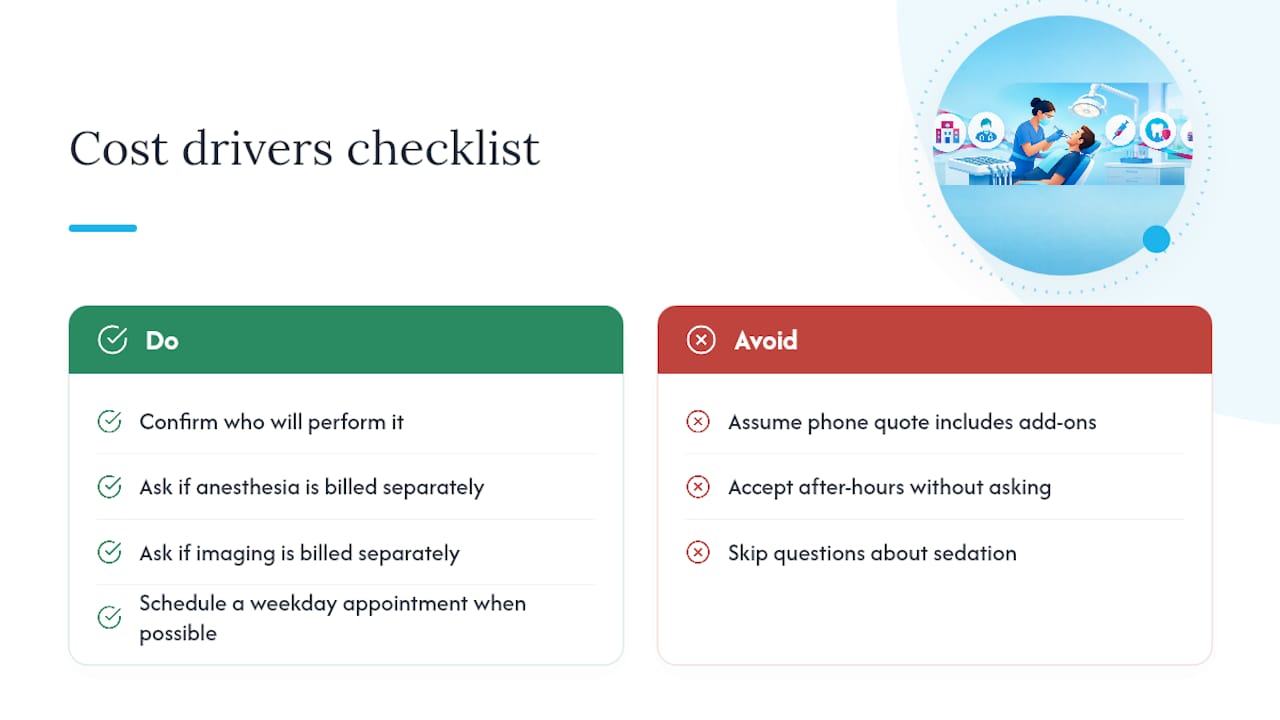
Who does the extraction matters. A general dentist typically charges less than an oral surgeon, but oral surgeons handle deeper impactions and complex root anatomy that a general practice may refer out. Hospital outpatient extractions carry facility fees on top of the procedure itself, which is one reason a tooth pulled in an ER setting costs more than the same tooth pulled in a dental chair.
Sedation level is its own line item. Local anesthesia is baked into most simple extractions. Nitrous oxide, IV sedation, or general anesthesia each add cost and usually require separate monitoring, which is why a nervous patient asking for “the good drugs” should expect a bigger bill than someone who tolerates a numbing shot.
Imaging and surgical extent add up fast. A single X-ray is cheap. A CBCT scan, bone removal, tooth sectioning, or an alveoloplasty to smooth the socket afterward all raise the total, especially if a bone graft or sinus lift becomes necessary.
Geography and timing play a role too, since after-hours and weekend emergency visits often carry a premium over a scheduled weekday appointment.
Pro Tip: Ask the front desk whether your quote includes anesthesia and imaging as separate charges before you agree to anything. A number that looks low on the phone can double once those add back in.
How Insurance, Medicare, and Medicaid Handle Emergency Extractions
Dental coverage for emergencies is inconsistent by design, and it catches a lot of people off guard mid-crisis.
Original Medicare generally excludes routine dental services, including extractions, except in narrow cases tied to a covered inpatient hospital stay or a procedure where the dental work is medically necessary alongside it. If you’re on Medicare and facing a standalone extraction, plan to pay out of pocket unless you carry a separate dental plan.
Private dental insurance works differently. Most plans use a tiered structure:
- In-network copays and coinsurance that are lower than out-of-network rates
- An annual deductible you meet before coverage kicks in
- An annual maximum benefit, often $1,000 to $2,000, after which you pay 100%
- Waiting periods of six to twelve months for “major” services, which can include surgical extractions
Marketplace plans may offer dental coverage as a separate add-on, and the coverage tier you pick (low versus high) changes your premium, copay, and deductible exposure. Medicaid dental benefits for adults vary significantly by state, with some states covering emergency extractions fully and others offering minimal adult dental benefits at all.
Before you commit to treatment, use a tool like the Fair Health consumer cost lookup to see typical charges in your area, and ask the practice to submit a pre-treatment estimate to your insurer so you know what they’ll actually pay before the drill starts. Reviewing your dental insurance information ahead of time makes that conversation faster.
Where Should You Go for an Emergency Extraction?
The setting you choose changes both the bill and the kind of care you get. Here’s how the three main options break down.
- General dentist or oral surgeon. This is where definitive treatment happens. A dental office can extract the tooth, manage the socket, and prescribe pain relief or antibiotics in one visit, usually at the lowest overall cost of the three options.
- Urgent dental clinic. These clinics specialize in fast turnaround for walk-in pain and swelling. They can often extract a tooth same-day without a prior appointment, though pricing tends to sit a bit above a routine scheduled visit because of the convenience factor.
- Emergency room. ERs are built to stabilize you, not to pull teeth. Expect antibiotics, pain control, and imaging to check for spreading infection, but expect to be referred to a dentist for the actual extraction. ER visits also carry the highest facility costs of the three.
Go straight to the ER if you have spreading facial or neck swelling, trouble breathing or swallowing, a high fever, or confusion. Those are signs infection has moved beyond the tooth, and that kind of untreated spread can become life-threatening.
What to Expect During and After the Procedure
A typical emergency visit follows a predictable sequence: exam and health history, an X-ray to confirm tooth position, a quick consent conversation, anesthesia, the extraction itself, then written aftercare instructions. Simple as that sounds, several of those steps show up as separate charges on your bill.
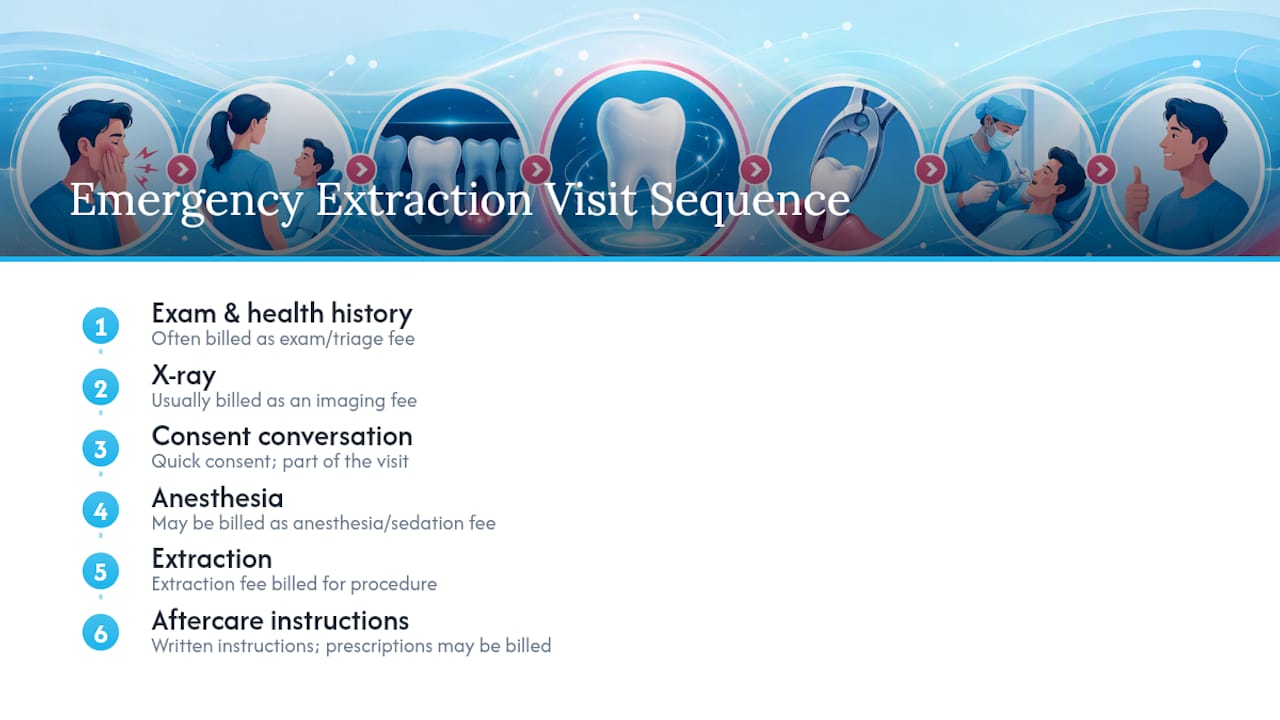
Common visit-level fees include an exam or triage fee, the X-ray, the extraction fee itself, anesthesia or sedation, and any prescriptions written afterward. Complete Dental Care’s emergency tooth pain guidance walks through what to do in the hours before you’re seen.
For pain control, the American Dental Association’s guidance favors NSAIDs, sometimes combined with acetaminophen, as first-line treatment rather than reaching for opioids by default. Antibiotics aren’t automatic either; the ADA recommends definitive treatment like extraction or drainage over routine antibiotics unless there’s evidence of systemic infection.
Recovery timeline: expect swelling and tenderness for the first 24 to 72 hours, with the socket largely healed over in one to two weeks. Call your dentist back if bleeding won’t stop, pain worsens after day three, or you develop a fever.
A Quick Checklist to Avoid Surprise Bills
Getting a realistic number before treatment starts takes about ten minutes on the phone. Here’s the order to do it in.
- Ask the clinic for a written, itemized pre-treatment estimate, not a verbal ballpark.
- Have the office submit that estimate to your insurer for a claims review so you know your actual coverage before you sit in the chair.
- Confirm the provider is in-network, or request a written good-faith estimate if they’re not.
- Ask about HSA or FSA eligibility, in-house membership plans, or financing options if you’re paying out of pocket.
- After treatment, keep every receipt and check your Explanation of Benefits (EOB) against what you were told beforehand.
Pro Tip: If a bill arrives higher than your written estimate and you weren’t told about an out-of-network provider in advance, you can dispute balance billing directly with the practice and your insurer’s claims department before paying it.
How Complete Dental Care Approaches Emergency Extractions
Same-day evaluations, digital scanning, and 3D imaging let the team assess an impacted or infected tooth quickly rather than sending you out for separate diagnostics. Emergency visits are handled with the same comfort-focused approach used across the practice, including clear explanations before any anesthesia or extraction begins.
- Same-day emergency evaluation when a tooth is broken, abscessed, or acutely painful
- In-house 3D imaging to assess impaction and root position without an outside referral
- A membership plan and financing options for patients without dental insurance
- A written estimate provided before treatment, not after
What the Cost Conversation Usually Gets Wrong
Most guidance on emergency extraction cost treats the number as the whole story. It isn’t. The real risk isn’t the $200 to $800 range itself, it’s the gap between what a patient assumes their insurance covers and what it actually pays, discovered after the fact on a bill they can’t argue with. That gap is almost entirely preventable with one phone call for a pre-treatment estimate, yet most people skip it because they’re in pain and just want the tooth gone.
The other place conventional advice falls short is the ER. Plenty of people in acute pain default to the emergency room because it feels like the fastest option. It rarely is the right one unless you have systemic symptoms. An ER can stabilize an infection, but it will not pull the tooth, and you’ll pay hospital facility rates for a referral you could have gotten from a phone call to a dental office.
If there’s one thing worth prioritizing above the dollar figure, it’s speed of diagnosis over speed of relief. A same-day exam with imaging tells you whether you’re dealing with a $150 extraction or a $900 surgical case, and that clarity is worth more than any guess you’d make from a search result.
— Complete Dental Care
Get a Same-Day Estimate for Your Emergency
A hospital ER will stabilize you and hand you a referral. An urgent care clinic will move fast but can’t always tell you the final number upfront. Some dental offices offer same-day evaluation with in-house 3D imaging, allowing patients to receive a diagnosis and a written estimate before treatment starts. Call the office or visit Complete Dental Care to describe your symptoms and get scheduled today. Have your insurance card, any recent dental X-rays, and a quick list of your symptoms ready. If you’re uninsured, ask about the practice’s membership plan when you call, since it can lower the cost of the visit before you even sit down.
This article is general information, not a substitute for advice from a qualified doctor. Consult a qualified healthcare professional about your own circumstances before acting on anything here.
Sources
- Medicare coverage: dental services
- Tooth pain — MedlinePlus
- Fair Health consumer cost lookup
- Healthcare
FAQ
Will an Emergency Dentist Pull a Tooth?
Yes. General dentists and oral surgeons routinely perform emergency extractions for broken, abscessed, or severely decayed teeth, often on the same day the problem starts. Cost depends on whether the extraction is simple or surgical.
Can a Dentist Pull a Rotten or Broken Tooth?
Yes, a badly decayed or fractured tooth is one of the most common reasons for an emergency extraction. If the tooth is broken below the gum line, it typically requires a surgical extraction rather than a simple one, which raises the cost.
What Is the 3-3-3 Rule for a Toothache?
This isn’t a recognized clinical standard from dental or medical authorities, and definitions vary widely depending on where you read it. If you have a toothache lasting more than a day or two with swelling or fever, skip informal rules and call a dentist directly.
Will the ER Pull a Tooth Out?
Generally no. Emergency rooms can manage pain, prescribe antibiotics, and check for spreading infection, but they typically refer the actual extraction to a dentist or oral surgeon. Go to the ER for airway trouble, spreading facial swelling, or fever; go to a dental office for the extraction itself.
Does Medicare Cover Emergency Tooth Extractions?
Usually not. Original Medicare excludes routine dental extractions except in narrow cases tied to a covered inpatient hospital stay. Check whether you have a separate Medicare Advantage dental benefit or Marketplace dental plan before assuming you’re covered.
questions about this? we're happy to help.
Every patient's situation is a little different. If you want to talk through what this means for you, our Greenville team is one call away.
schedule a free consultation