A zirconia full arch is a fixed, implant-supported prosthesis carved primarily from solid zirconia, built to replace an entire row of teeth without ever coming out of the mouth. It gives you strength and stain resistance that acrylic dentures can’t match, along with a bite that feels like real teeth again. The tradeoff is real, too: higher upfront cost, longer planning time, and a design that has to be engineered correctly the first time, since fixing a poorly planned zirconia arch is harder than adjusting a denture.
TL;DR:
- Monolithic zirconia offers the highest fracture resistance and fewer chipping issues compared to veneered zirconia, which is more prone to porcelain layer fractures.
- A minimum of four to eight implants are typically required per arch, with proper planning of implant angle and spacing being crucial to prevent framework fractures.
- Total treatment time can extend from several months to over a year if grafting or healing complications occur, emphasizing the importance of thorough planning.
- Zirconia prostheses have a survival rate between 88% and 100% over one to seven years, with monolithic designs performing slightly better in short-term studies.
- Upfront costs are significantly higher—about $7,829 more on average than hybrid options—but long-term durability and fewer repairs may justify the investment.
questions about this? we're happy to help.
Every patient's situation is a little different. If you want to talk through what this means for you, our Greenville team is one call away.
schedule a free consultationTable of Contents
- What Is a Zirconia Full-Arch Prosthesis Made Of?
- Who Is a Good Candidate for a Zirconia Full Arch?
- What Does the Zirconia Full-Arch Treatment Process Look Like?
- Monolithic, Veneered, or Hybrid: Which Zirconia Design Wins?
- Zirconia vs. Acrylic-Titanium Hybrids: Which Lasts Longer?
- What Are the Risks and Survival Rates for Zirconia Full-Arch Implants?
- How Much Does a Zirconia Full Arch Cost Long-Term?
- How Do You Choose the Right Provider for a Zirconia Full Arch?
- How Complete Dental Care Plans Zirconia Full-Arch Cases
- Ready to Explore Your Full-Arch Options?
- Sources
- FAQ
What Is a Zirconia Full-Arch Prosthesis Made Of?
A zirconia full arch comes in three main builds, and the difference between them matters more than most patients realize going in. Monolithic zirconia is milled from a single solid block, giving it the highest fracture resistance and the fewest chipping problems. Veneered zirconia layers porcelain over a zirconia base for a softer, more translucent look, but that porcelain layer is the weak point and the most common site of chipping. Zirconia-on-titanium designs bond a milled zirconia arch to a titanium bar substructure, which cuts weight and gives the framework some flex where a rigid one-piece design would crack.
Retention matters too. Screw-retained arches can be removed by a dentist for repair or hygiene access, which most clinicians prefer for retrievability. Cement-retained versions are harder to remove if something goes wrong underneath.
Who Is a Good Candidate for a Zirconia Full Arch?
You’re likely a candidate if you have a failing or terminal set of teeth, wear dentures that no longer stay put, or want a permanent fixed alternative to removable prosthetics. Clinicians typically evaluate a few things before recommending zirconia over other materials:
- Bone volume and density available for implant placement, since thin or resorbed ridges may need grafting first
- Number of implants planned, usually four to eight per arch depending on bone quality and bite forces
- Interarch space, since zirconia needs adequate vertical room to avoid a bulky or fragile design
- Bruxism severity, because heavy grinding raises fracture risk regardless of material
- Active periodontal disease, uncontrolled diabetes, or smoking, all of which affect healing and long-term implant stability
What Does the Zirconia Full-Arch Treatment Process Look Like?
The path from consultation to a finished zirconia arch usually runs through five distinct phases, and skipping steps is where most complications start.
- Diagnostics and planning. A CBCT scan maps bone volume and nerve position, while an intraoral scan or photogrammetry captures the bite and soft tissue. Photogrammetry-based workflows in particular have shown higher accuracy in implant positioning than traditional scan stitching across a full arch, which matters because a small measurement error early on becomes a fit problem later.
- Implant placement. Implants go in either immediately, if bone quality allows, or in stages after grafting. Angulation and spacing are planned around where the final prosthesis needs support, not just where bone happens to be available.
- Provisional phase. Many patients leave surgery day with a temporary fixed arch, often called “teeth in a day.” Others heal for three to six months before any fixed prosthesis goes on, depending on bone stability.
- Final zirconia delivery. Once tissue and bone have settled, the permanent zirconia arch is fabricated and fitted, checking bite, fit, and passivity before it’s finalized.
- Follow-up. Adjustments and hygiene checks continue for months after delivery.
Grafting, sinus lifts, or healing complications can stretch the total timeline from a few months to over a year.
Monolithic, Veneered, or Hybrid: Which Zirconia Design Wins?
Monolithic zirconia holds up best against chipping because there’s no porcelain veneer layer to fracture off. Reviews of implant-supported zirconia note fewer veneer-related failures with monolithic designs compared to veneered frameworks, though veneered zirconia still wins on natural-looking translucency in the smile zone.
The mandible adds a wrinkle most patients never hear about: your lower jaw flexes slightly during function, and a rigid, one-piece zirconia arch that ignores that flex concentrates stress right at the midline. That’s why segmented frameworks or a titanium interface are commonly used to absorb the movement instead of fighting it. Design also has to respect connector cross-section and cantilever length. Long unsupported extensions past the last implant are the single biggest predictor of framework fracture in retrospective data, so a well-planned arch keeps those cantilevers short.
Zirconia vs. Acrylic-Titanium Hybrids: Which Lasts Longer?
Zirconia beats acrylic-titanium hybrids on raw durability. A retrospective analysis comparing the two found zirconia prostheses survived at 93.7% versus 83.0% for metal-acrylic hybrids at five years. Acrylic teeth wear down, stain, and chip off their metal frameworks over time in a way solid zirconia simply doesn’t.
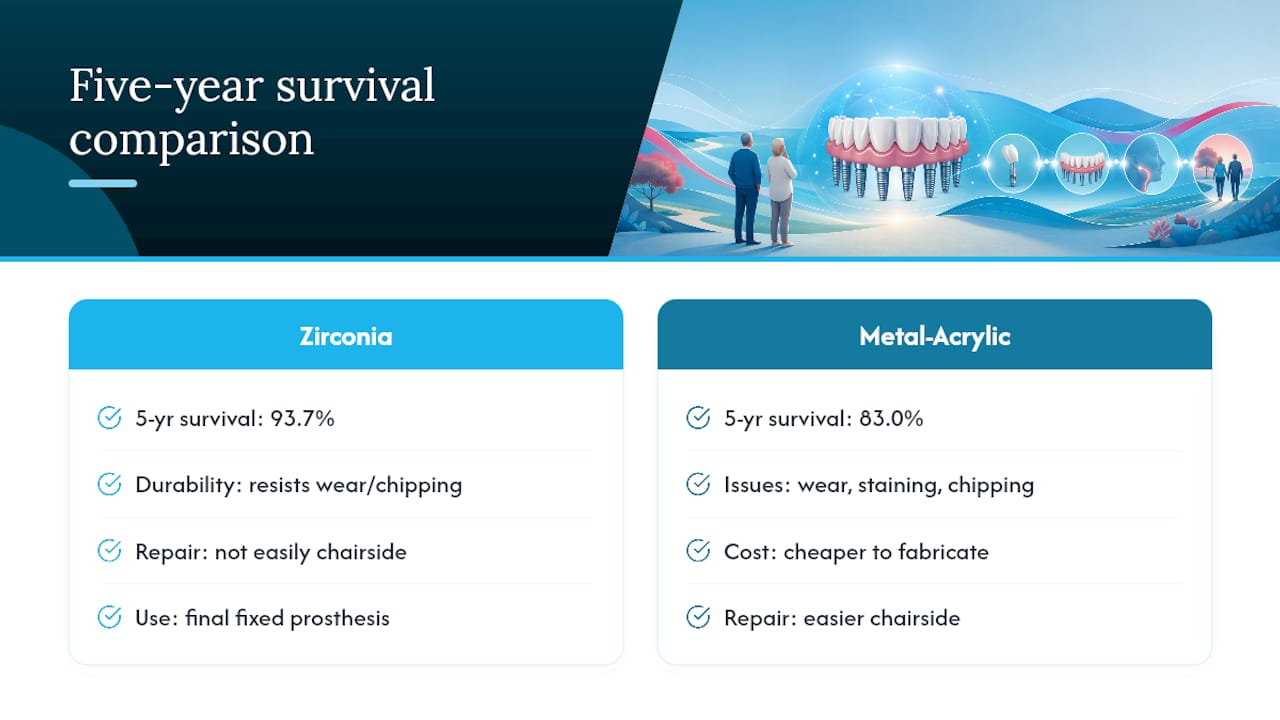
Acrylic hybrids still have their place. They’re cheaper to fabricate, easier to repair chairside if a tooth breaks, and can serve as a lower-cost staged step before committing to zirconia. For patients on a tighter budget or those who want a trial run with a fixed prosthesis before the final version, that flexibility matters more than the durability gap.
What Are the Risks and Survival Rates for Zirconia Full-Arch Implants?
The most common complications are prosthetic, not biological: chipping (mostly in veneered designs), screw loosening, and, less often, framework fracture from an overloaded cantilever. Most of these are repairable chairside or in the lab without removing implants. Peri-implantitis, a bone-and-gum infection around the implant itself, is tracked separately from prosthesis survival and depends more on hygiene access and implant positioning than on the zirconia itself.
By the numbers: Across narrative reviews of implant-supported zirconia, reported prosthetic survival rates generally fall between 88% and 100%, with most studies following patients for one to seven years or longer. Smaller case series of monolithic zirconia specifically report success rates around 96% over follow-ups of up to three and a half years, though long-term randomized trials are still limited.
Passive fit, correct implant number for the bite forces involved, and respecting connector and cantilever limits are the biggest levers a clinician has to keep those numbers on the high end.
How Much Does a Zirconia Full Arch Cost Long-Term?
Cost is driven by implant count, lab fabrication fees, whether the design is monolithic or hybrid, and whether grafting or sedation is needed. Zirconia carries a real premium up front. That same retrospective cost-effectiveness analysis that found the higher survival rate also estimated an average fabrication cost difference of about $7,829 more than a metal-acrylic hybrid. The payoff shows up later: fewer remakes and repairs over years of wear can close some of that gap.
Get itemized quotes rather than a single bundled number, and ask directly what’s covered if something chips or a screw loosens in year two. Financing plans, dental insurance, and in-house membership plans can all offset the upfront number, and it’s worth reading a full breakdown of full-arch cost factors before assuming zirconia is out of reach.
How Do You Choose the Right Provider for a Zirconia Full Arch?
The lab and the clinician matter as much as the material. A digital-first workflow, meaning CBCT imaging, intraoral scanning, and CAD/CAM design rather than old-style impressions, gives a more predictable fit before the arch ever gets milled.
Before committing, ask your provider:
- How many implants are planned for your specific arch, and why that number
- Whether they’re recommending monolithic or veneered zirconia, and why for your case
- Whether a titanium interface or segmented design is being used, especially for the lower arch
- What their complication history looks like, and how repairs are typically handled
- Whether they can show documented outcomes or before-and-after cases, not just stock photos
Walk away from anyone vague on timelines or unwilling to show real case documentation.
Pro Tip: Ask specifically about cantilever length and connector cross-section in your treatment plan. These two dimensions are among the strongest predictors of framework fracture in the research, and a provider who can answer confidently is one who’s actually planning your case, not emulating it.
How Complete Dental Care Plans Zirconia Full-Arch Cases
Complete Dental Care builds every full-arch plan around 3D imaging and digital scanning first, so the implant positions and prosthetic design are mapped before any drilling starts. The practice pairs that planning with a patient-first approach to communication and anxiety, including a video library patients can review before committing to treatment.
— Complete Dental Care
Ready to Explore Your Full-Arch Options?
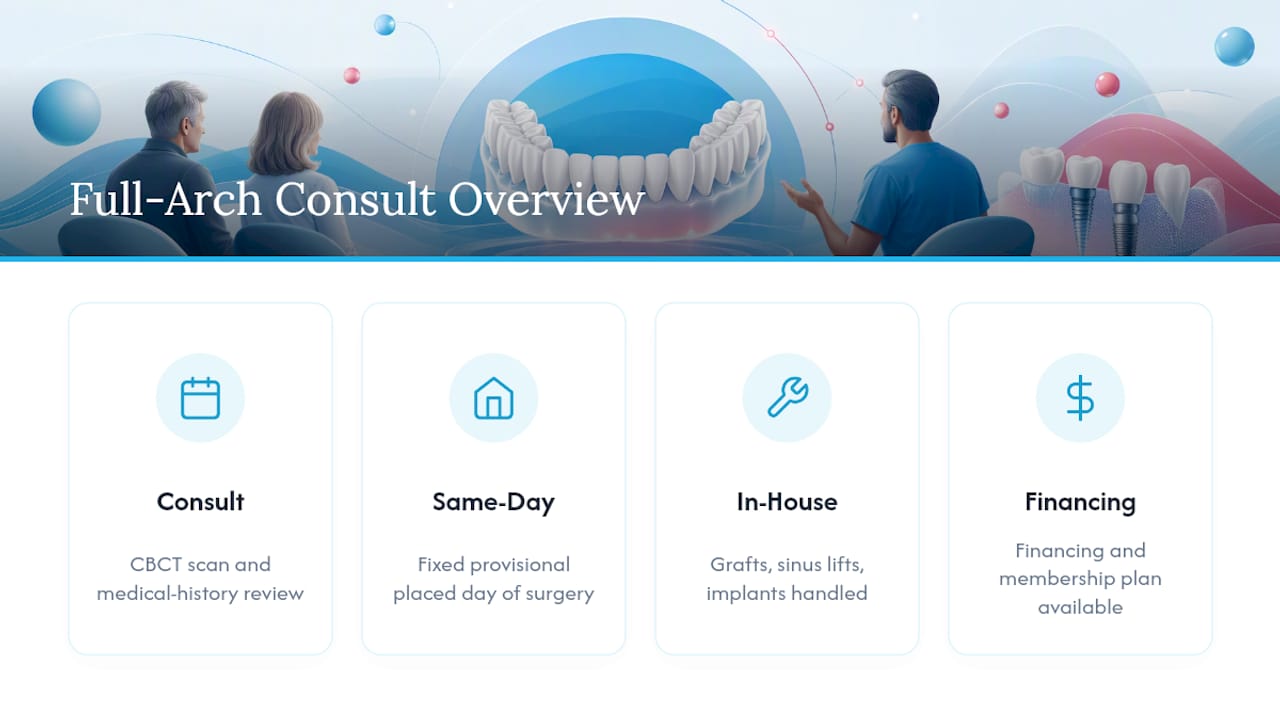
If you’ve been weighing zirconia against acrylic hybrids or removable dentures, the honest next step is a real diagnostic consult, not another article. Complete Dental Care’s Teeth in a Day option lets qualifying patients leave with a fixed provisional the same day as surgery, backed by the same digital planning and 3D imaging used for the final zirconia restoration. Your first visit typically includes a CBCT scan, a review of your medical history, and a straightforward conversation about which implant count and design fit your bite and budget.
For patients who need grafting, sinus lifts, or multiple implants placed before a prosthesis goes on, the surgical and implant dentistry team handles that groundwork in-house rather than referring it out. Financing and a membership plan are available for patients managing cost without traditional insurance. Schedule a consult to get an itemized plan specific to your arch, not a generic estimate.
This article is general information, not a substitute for advice from a qualified doctor. Consult a qualified healthcare professional about your own circumstances before acting on anything here.
Sources
- Long-term Clinical Outcomes and Cost-Effectiveness of Full-Arch Implant-Supported Zirconia-Based and Metal-Acrylic Fixed Dental Prostheses: A Retrospective Analysis
- The Use of Zirconia for Implant-Supported Fixed Complete Dental Prostheses: A Narrative Review
FAQ
How Much Does a Full-Arch Zirconia Implant Bridge Cost?
Pricing depends on implant count, lab fees, and design complexity, so Complete Dental Care provides itemized quotes rather than a flat number; current pricing details are available directly through the full-arch cost guide. One retrospective analysis found zirconia fabrication costs run about $7,829 higher on average than metal-acrylic hybrids.
How Long Do Zirconia Full-Arch Bridges Last?
Reported prosthetic survival for implant-supported zirconia generally falls between 88% and 100% across multi-year studies, with many patients tracked for one to seven years or more. A five-year retrospective comparison found zirconia surviving at 93.7% versus 83.0% for metal-acrylic hybrids.
What Are the Downsides of a Zirconia Dental Implant Prosthesis?
The main downsides are higher upfront cost, a longer planning process, and the fact that veneered zirconia can chip at the porcelain layer. Monolithic zirconia largely avoids that chipping risk but requires precise design around cantilever length and connector thickness to prevent framework fracture.
What Is the Failure Rate of Zirconia Implants?
Failure isn’t a single number since prosthetic complications (chipping, screw loosening, fracture) are tracked separately from implant loss itself. Reported prosthetic survival runs 88% to 100% across reviewed studies, meaning most failures involve a repairable prosthetic issue rather than losing the implant.
questions about this? we're happy to help.
Every patient's situation is a little different. If you want to talk through what this means for you, our Greenville team is one call away.
schedule a free consultation