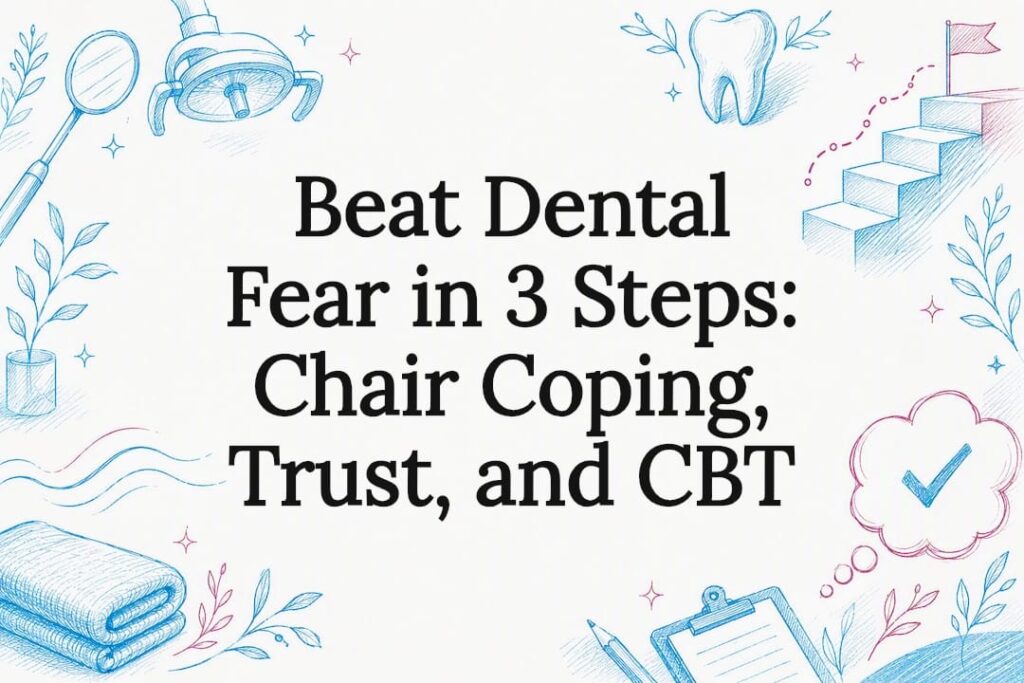
You can reduce or overcome a fear of the dentist, and most people who do it use the same three-part approach: immediate coping tactics for the chair itself, a treatment plan built on trust with your dental team, and, when the fear runs deep, evidence-based behavioral therapy like CBT or gradual exposure. Sedation has a role, but it works best as a bridge, not a fix. Start by calling your dental office and telling them exactly what scares you.
TL;DR:
- Most dental fear can be managed with immediate coping tactics, trust-building with the dental team, and behavioral therapy like CBT or exposure.
- Severe anxiety or phobia requires structured therapy before treatment and may benefit from staged appointments and sensory adjustments.
- Techniques such as breathing exercises, distraction, and setting stop signals are effective during visits, while sedation options should complement, not replace, behavioral approaches.
- Evidence shows CBT and graded exposure reduce pre-treatment fear significantly more than sedation, with some patients seeing results in just a few sessions.
- Planning ahead, honest communication about triggers, and early follow-up help build confidence and improve long-term dental care experience.
questions about this? we're happy to help.
Every patient's situation is a little different. If you want to talk through what this means for you, our Greenville team is one call away.
schedule a free consultationTable of Contents
- How to Recognize Dental Fear vs. Dentophobia
- What Can You Do Before and During an Appointment?
- Do CBT and Exposure Therapy Actually Work for Dental Fear?
- What About Nitrous Oxide, Sedation, and General Anesthesia?
- How Do You Prepare for a Visit and Build Trust With Your Dentist?
- A Clinic’s View on Treating Anxious Patients
- Ready to Book a Visit That Works for You?
- Sources
- FAQ
How to Recognize Dental Fear vs. Dentophobia
Dental fear is common and usually tied to a specific trigger: the sound of the drill, the smell of the office, a bad memory from childhood. Dentophobia goes further. It’s persistent, it drives outright avoidance, and it can meet the clinical bar for a specific phobia. The distinction matters because it points you toward the right fix. A person with mild fear might just need noise-canceling headphones. Someone with phobia often needs structured therapy before they can sit through a cleaning.
Watch for these signs, physical, mental, and behavioral alike:
- A racing heart, sweating, or nausea in the waiting room
- Catastrophic thoughts (“something will go wrong,” “I won’t be able to breathe”)
- Panic or tears triggered by dental smells or sounds
- Repeatedly canceling or simply never scheduling appointments
Avoidance is the trap. Skipped visits let small problems turn into root canals and extractions, which then reinforces the fear that started the cycle. The Modified Dental Anxiety Scale is a five-question screening tool many clinics use to gauge severity: scores of 5 to 10 suggest mild anxiety, moderate scores indicate a higher level, and the highest scores signal severe anxiety or phobia that often benefits from a referral to a therapist alongside dental care.
What Can You Do Before and During an Appointment?
Small, practical moves change how your body responds in the chair. None of these require a prescription.
- Breathe first. Box breathing (inhale 4 seconds, hold 4, exhale 4, hold 4) for two minutes before you walk in calms your nervous system faster than trying to “think positive.”
- Bring your own distraction. A playlist, an audiobook, or noise-canceling headphones gives your brain something else to process. Audiovisual distraction and guided breathing are recommended precisely because they’re low risk and consistently help.
- Ask for sensory adjustments. Dimmer lights, a weighted lap blanket, or a request to skip strong-scented products are reasonable asks most offices will accommodate.
- Set a stop signal. Agree on a raised hand or a tap that means “pause now.” Knowing you have an exit valve reduces the panic itself.
- Time it well. Book morning slots before your anxiety has all day to build, skip caffeine beforehand, and bring a trusted friend if the office allows it.
Pro Tip: Ask your dentist for topical numbing gel before any injection. It’s a two-minute step that removes the part most people dread the most, the needle prick itself.
Do CBT and Exposure Therapy Actually Work for Dental Fear?

Behavioral therapy beats sedation for one specific outcome: lowering fear before treatment even starts. A 2024 meta-analysis found CBT and related behavioral approaches produced a significantly larger reduction in pre-treatment dental anxiety than inhalational sedation, with an effect size (SMD) of −0.87 and a P value under 0.0001. That’s not a marginal edge. It’s a meaningfully bigger drop in reported fear.
The mechanism is straightforward:
- Cognitive restructuring targets the catastrophic thoughts (“I’ll choke,” “this will never end”) and replaces them with more accurate ones.
- Graded exposure introduces dental stimuli step by step, sometimes starting with just sitting in the waiting room, then the chair, then a mirror exam, so the nervous system stops treating the dentist’s office as a threat. A clinical overview of exposure and CBT describes this staged approach as foundational for treating specific dental fears.
- Relaxation training paired with either of the above extends the benefit beyond the office.
Timelines vary. Some patients see real change after four to six CBT sessions with a therapist; others get meaningful relief from a single, longer “brief CBT” conversation built into a dental visit itself. A broader literature review on managing dental anxiety and phobia backs this combined approach, recommending psychotherapeutic techniques be implemented alongside clinical supports rather than instead of them. If your goal is lasting change, not just getting through one appointment, this is where to put your effort.
What About Nitrous Oxide, Sedation, and General Anesthesia?
Sedation has a legitimate place in anxiety care, but it treats the appointment, not the fear itself. Understanding the options helps you have a real conversation with your dentist instead of just asking for “something to knock me out.”
- Nitrous oxide (laughing gas) wears off within minutes and suits mild to moderate anxiety for routine procedures.
- Oral sedatives taken before the visit work well for moderate anxiety and longer procedures, though you’ll need someone to drive you home.
- IV sedation offers deeper relaxation for more invasive work and requires monitoring by a trained provider.
- General anesthesia is reserved for severe phobia, extensive surgical work, or patients who can’t tolerate treatment any other way.
Contraindications exist for each, from certain medications to respiratory conditions, so this is a conversation your dentist needs to have with your full medical history in hand. Here’s the catch worth knowing: research on managing adult dental anxiety warns that leaning on sedation alone, appointment after appointment, can actually maintain the avoidance pattern instead of resolving it. The fear is still there when the drug wears off. Ask your office whether staged treatment, longer first visits, or a referral for specialized sedation dentistry makes more sense for your situation than defaulting to the deepest option available.
How Do You Prepare for a Visit and Build Trust With Your Dentist?
A good first visit starts before you ever sit in the chair, and effective marketing strategies can help you find a practice that understands your needs and communicates clearly with patients (Dentist SEO Services | Be Discovered & Book More Patients).
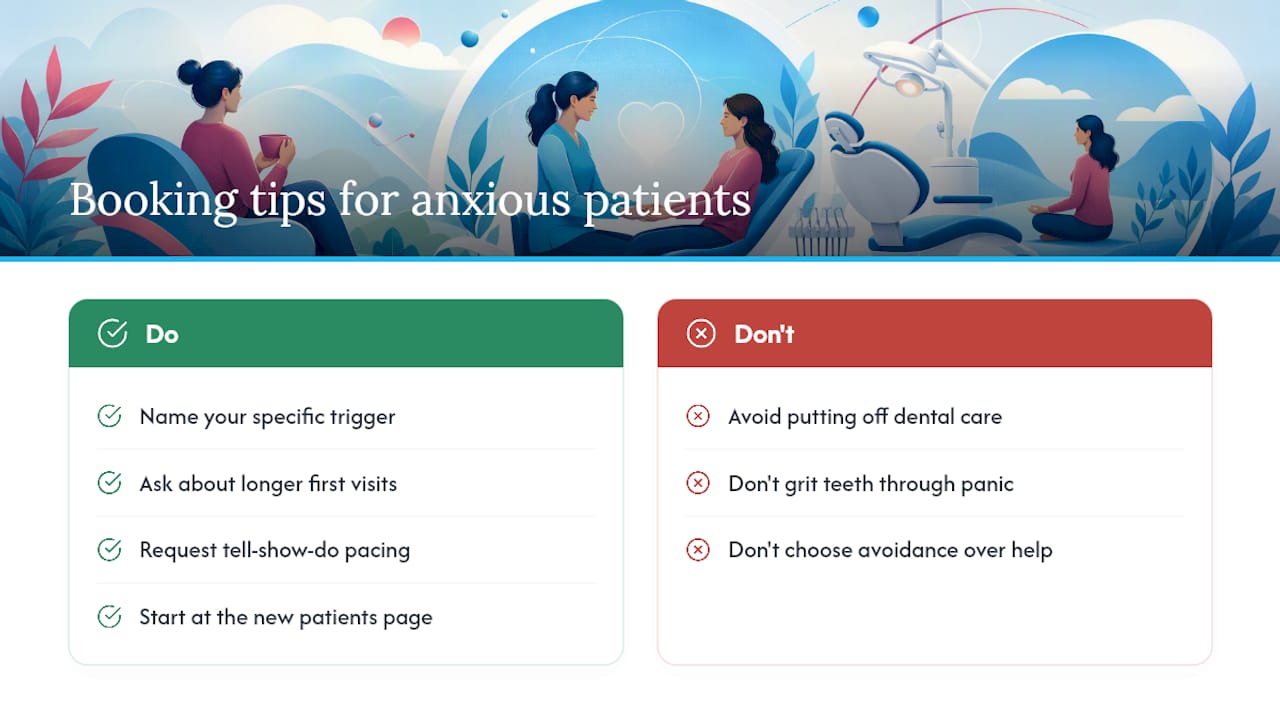
- When you book, tell the front desk specifically what triggers your fear, not just “I’m nervous.” Ask if they screen for anxiety using a tool like the MDAS, and request a longer appointment slot if one’s available.
- When you arrive, agree on your stop signal, confirm how long the visit will run, and ask for “tell-show-do” pacing, where the dentist explains and demonstrates each step before doing it. This kind of clear, collaborative communication is a consistently recommended way to lower a patient’s anxiety in the moment.
- After the visit, book a short, low-stakes follow-up soon after. Confidence builds through repetition, not through trying to power through a two-hour procedure on your first try back.
Review what to expect at a first appointment before you go, and treat that early visit as data collection: what worked, what didn’t, what to ask for differently next time.
A Clinic’s View on Treating Anxious Patients
Most dental fear isn’t really about the drill. It’s about losing control in a chair you can’t easily leave. Complete Dental Care builds its general dentistry visits around that reality: individualized plans, 3D imaging that shows patients exactly what’s happening before any instrument comes near their mouth, and staged treatment instead of cramming everything into one overwhelming appointment. A stop signal costs nothing to offer. A longer first visit costs a little more scheduling flexibility. Both change whether a fearful patient comes back.
— Complete Dental Care
Ready to Book a Visit That Works for You?
You don’t have to choose between avoiding the dentist and gritting your teeth through a panic attack. Complete Dental Care builds appointments around patients who’ve put off care for years, with staged treatment plans, sedation options when they genuinely help, and restorative paths like Teeth in a Day for people whose fear let a small problem become a bigger one. If a needle or a drill has kept you away from restorative or implant care, that’s exactly the kind of case this practice is built to handle differently. Call and use the checklist from this article: name your specific trigger, ask about longer first visits, and request tell-show-do pacing. Start at the new patients page to see what a first visit actually involves.
This article is general information, not a substitute for advice from a qualified doctor. Consult a qualified healthcare professional about your own circumstances before acting on anything here.
Sources
- Meta-analysis on behavioral therapy vs inhalational sedation for dental anxiety (2024)
- Review of non-pharmacological interventions for dental anxiety
- Clinical overview of exposure therapy and CBT for dental fear
- Strategies to manage patients with dental anxiety and dental phobia: literature review
FAQ
What Is the 3-3-3 Dental Rule?
There’s no clinically established “3-3-3 rule” in dental anxiety literature; it’s a term that circulates informally online without a consistent definition, so it’s not something to rely on for treatment decisions.
What Is the Most Feared Dental Procedure?
Root canals and extractions consistently top patient fear surveys, largely because of anticipated pain and the sound of dental instruments, even though modern anesthesia makes both far less uncomfortable than their reputation suggests.
How Do People With Anxiety Manage Dentist Visits?
Most manage it by combining short-term coping tools, like breathing exercises and agreed stop signals, with a dental team that offers staged treatment and clear communication, and some also work with a therapist on CBT or graded exposure for longer-term change.
What Can I Take to Calm My Nerves Before a Dentist Visit?
Simple breathing techniques like box breathing, avoiding caffeine beforehand, and using distraction like music or a guided imagery app all help without any medication; for anything pharmacological, including mild oral sedatives, talk to your dentist first since options depend on your health history.
questions about this? we're happy to help.
Every patient's situation is a little different. If you want to talk through what this means for you, our Greenville team is one call away.
schedule a free consultation